

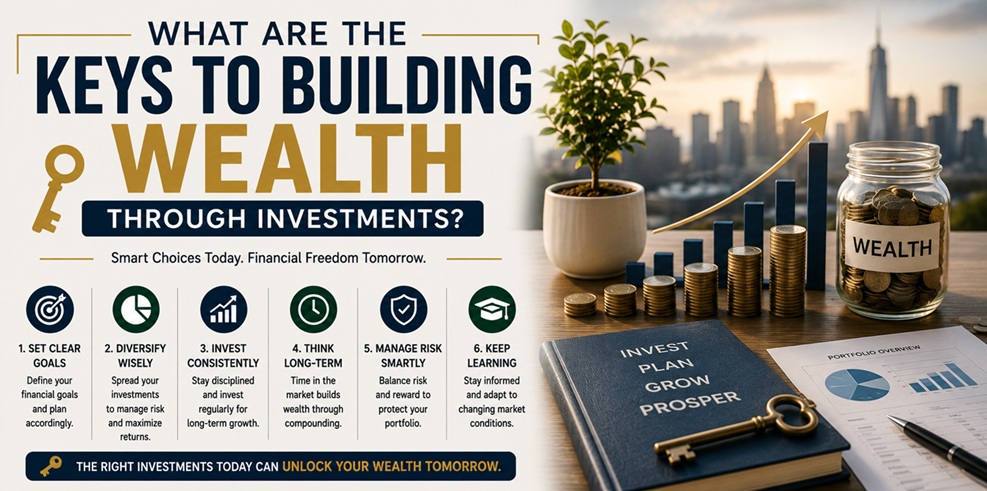
Building wealth through investments comes down to five principles that virtually every credible research source agrees on: start early, invest consistently, stay diversified, keep costs low, and don’t sell during downturns. These principles are unglamorous, repeatedly proven, and almost never followed completely because each one fights against natural human instinct.
The reason these specific principles work is the math of compounding. Returns earn returns on returns over decades. Anything that interrupts compounding — late starts, panic selling, high fees, concentrated bets — costs disproportionately. The investors who build the most wealth aren’t the smartest; they’re the ones who let the math run uninterrupted for the longest time.
The 5 Keys
| Key | Why It Matters | Common Violation |
|---|---|---|
| Start early | Compounding time is non-recoverable | “I’ll start when I make more” |
| Invest consistently | Removes timing decisions, captures dollar-cost averaging | Stopping during downturns |
| Stay diversified | Reduces single-asset risk | Concentrating in employer stock |
| Keep costs low | Fees compound just like returns do (negatively) | High-fee actively managed funds |
| Don’t sell during downturns | Locks in losses, breaks compounding | Panic-selling at market bottoms |
Start Early: The Math That Matters Most
A 25-year-old investing $300/month at 7% has roughly $720,000 by age 65. A 35-year-old investing the same has about $340,000 by 65. A 45-year-old has about $145,000.
Starting 10 years earlier more than doubles the result — not because the early investor saves more total dollars, but because those early dollars have an extra decade of compounding. Time isn’t just a factor; it’s the most powerful factor.
Invest Consistently: Why Timing Doesn’t Beat Time
Multiple studies have shown that missing the 10 best market days over a 20-year span cuts total returns roughly in half. The catch: the best days cluster around the worst days. Investors who exit during volatility almost always miss the rebound.
Consistent monthly investing through automated contributions avoids this problem. You’re never trying to time the market because you’re always in it.
Stay Diversified: The One Free Lunch
Diversification is the closest thing to a free lunch in investing — it reduces risk without necessarily reducing expected return. A broad-market index fund holds thousands of companies; if any one fails, the impact on your portfolio is minor.
Common diversification mistakes:
- Holding too much employer stock (concentrated risk in your job and investments simultaneously)
- Owning many funds that hold the same underlying stocks
- Going all-in on one country, sector, or theme
A simple diversified portfolio: a U.S. total market index fund, an international total market index fund, and a bond fund — proportions adjusted by age and risk tolerance. This three-fund approach has outperformed most professional managers over long horizons.
Keep Costs Low: The Silent Wealth-Killer
A 1% annual fee sounds small. Over 30 years, it can consume 25% of your final portfolio value. Compounded fees compound against you the same way compounded returns compound for you.
Costs to watch:
- Mutual fund expense ratios — target under 0.20% for index funds
- Advisory fees — 1% AUM adds up; flat-fee advisors often serve smaller portfolios better
- Trading commissions — generally zero now at major brokers
- Bid-ask spreads — small but real on less-traded funds
- Taxes — tax-loss harvesting and account location strategy matter
Don’t Sell During Downturns: The Behavioral Test
This is the principle that separates investors who build wealth from those who don’t. Markets fall. Often. Sometimes a lot. Selling locks in losses; staying invested allows recovery.
The recipe most successful investors follow:
- Set asset allocation when you’re calm
- Don’t change it because of headlines
- Rebalance annually (this naturally sells high and buys low)
- Avoid checking accounts daily during downturns
What the Keys Don’t Include
Notably absent: stock picking, market timing, finding the next big thing, chasing hot sectors. These are popular topics in financial media. They’re not how most wealth is actually built. Decades of data show active managers underperform indexes after fees, and individual investors underperform the funds they own (because of bad timing decisions).
Bottom Line
The keys to building wealth through investments have been the same for as long as we’ve studied investing: start early, invest consistently, stay diversified, keep costs low, don’t sell during downturns. Each is simple to understand. Each fights against an emotional impulse. The investors who follow them consistently for decades end up wealthy. The ones who don’t end up busy.
