

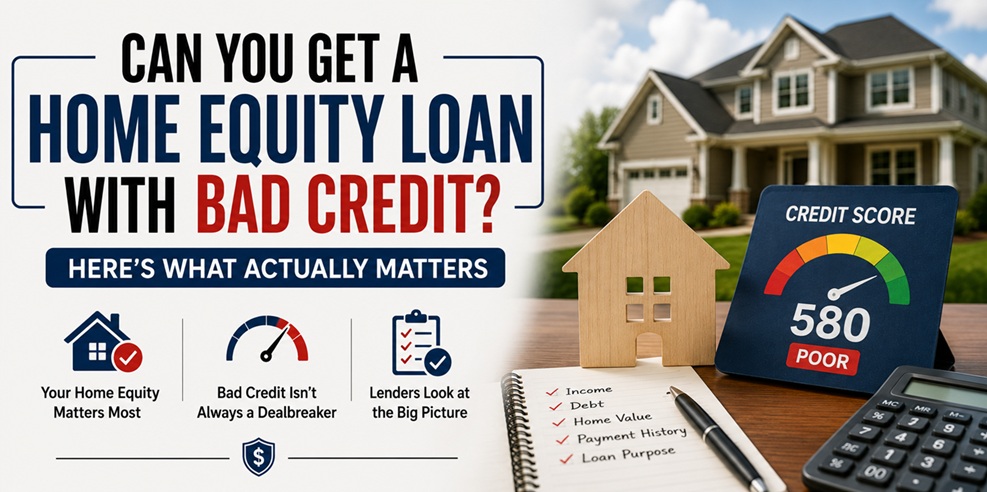
Yes, you can get a home equity loan with bad credit — but your credit score is just one of five things lenders weigh, and it’s often not the most important. Equity in your home, debt-to-income ratio, income stability, and loan-to-value ratio all influence approval as much or more than your FICO number.
Most mainstream banks set a 620 minimum. A meaningful number of credit unions and online portfolio lenders go down to 580. A few specialty lenders work even lower when other factors are strong. The catch is the rate — expect to pay 2 to 4 percentage points more than a borrower with a 720 score, sometimes more.
What “Bad Credit” Actually Means to a Lender
| Score Range | Lender Category | Likely Outcome |
|---|---|---|
| Below 580 | Specialty/hard money only | Very limited, high cost |
| 580–619 | Credit unions, portfolio lenders | Possible with strong equity |
| 620–679 | Most lenders open | Approved, above-average rate |
| 680–719 | Standard market | Competitive rates |
| 720+ | Best terms available | Lowest rates, highest LTV |
The 580 mark is where the market really starts to open up, even if just a little.
The 5 Factors That Actually Drive Approval
Equity. Most lenders cap your combined loan-to-value (CLTV) at 80–85%. If your home is worth $400,000 and you owe $250,000, you have $150,000 of equity — and lenders will typically let you tap $70,000–$90,000 of it.
Debt-to-income ratio. Under 43% is the usual cutoff. Under 36% gets you better terms. This is more fixable than your score in the short term — pay down a credit card, and your DTI moves immediately.
Income stability. Two years in the same job or industry often beats a higher score with a 6-month-old job, in underwriters’ eyes.
Loan-to-value. Asking for 60% LTV is a totally different conversation than asking for 85%. Lower LTV improves your odds with bad credit, materially.
Credit score. Important, but the floor, not the ceiling. Underwriters look at why your score is low — a recent late payment is read differently than a five-year-old bankruptcy.
Realistic Rate Expectations
If a 720-score borrower is being quoted, say, 8% on a home equity loan, here’s roughly what other ranges look like:
| Credit Score | Approximate Rate Premium |
|---|---|
| 720+ | Baseline rate |
| 660–719 | +0.5% to 1% |
| 620–659 | +1.5% to 2.5% |
| 580–619 | +3% to 4%+ |
On a $50,000 loan over 15 years, a 3-point rate jump costs roughly $90 more a month and around $16,000 more over the life of the loan. That’s the real price of bad credit on a home equity loan.
Where to Look
Skip the big national banks first. Try:
- Credit unions — Navy Federal, PenFed, and local credit unions tend to be more flexible than banks
- Online portfolio lenders — companies that hold their own loans can set their own rules
- Community banks — usually willing to look at the full picture, not just the score
Worth Saying Out Loud
A home equity loan puts your house on the line. If your credit is bad because of unstable income, foreclosure is a real risk. Borrow only what your monthly budget can absorb even in a rough month, and don’t use this to consolidate credit card debt unless you have a real plan to not run the cards back up.
Before you apply, pull your credit report (free at AnnualCreditReport.com) and check for errors. Disputing inaccuracies can move your score 20–40 points in 30 days. That’s the cheapest rate cut you’ll ever get.
